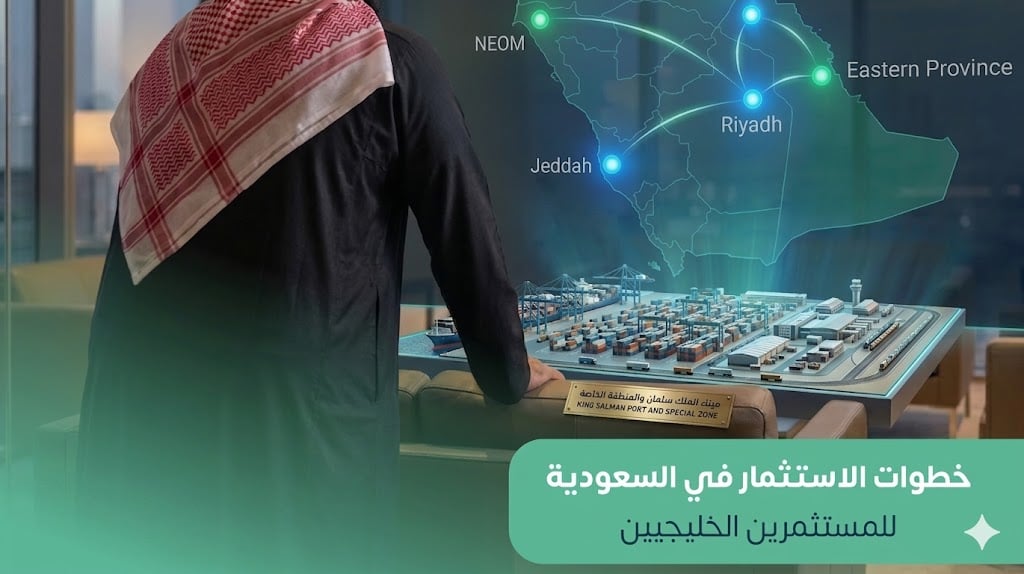
Direct and indirect foreign investment represent the two main ways for you to enter the Saudi market, and each has its own tools and legal path. The first gives you administrative influence and direct participation in building the local economy, while the second provides you with flexible access to emerging financial markets.
Your decision will no longer be random, but will be based on a strategic vision that puts you in the right place in one of the world’s fastest growing economies.
In this article, we will draw up a practical roadmap that tells you which of the two options suits your capital size, level of experience, and the nature of the risks you can accept.
We will also answer all your questions about the possibility of entering the Saudi market as a foreign investor through each route, so keep reading to discover for yourself which of the two routes will create for you a more stable and sustainable wealth in light of Vision 2030.
Abdulaziz bin Yasser Al-Anzi Law Firm
Definition of foreign direct investment
Foreign direct investment (FDI) can be defined as a type of international investment in which a resident entity (the "direct investor") in one economy acquires a permanent and significant interest in a resident enterprise in another economy (the "direct investment project").
This enduring interest reflects a long-term investment relationship characterized by the investor's ability to exercise an influential degree of management or control over the project's operational policies.
This form of investment embodies the transfer of capital across borders with the aim of establishing or owning a substantial share in productive assets within the host country, thereby having an effective influence on the management and direction of those assets.
Foreign direct investment takes several legal forms, most notably: full ownership of a branch or subsidiary, or the establishment of an entirely new project, orMerger or acquisitionBased on an existing entity, or partnering with a local investor by creating a joint venture.
The importance of foreign direct investment
Foreign direct investment is a strategic tool for achieving sustainable development; its importance lies in the following aspects:
- Stimulating GDP and contributing to expanding the economic base by injecting foreign capital into the productive and service sectors.
- Diversifying income sources and supporting economic diversification strategies, and reducing dependence on traditional sectors such as "oil".
- Boosting international trade, which is often linked to an increase in the volume of exports and imports.
- Transferring advanced technologies, modern management methods, and marketing knowledge, thereby creating a qualitative leap in productivity.
- Contributing to raising the efficiency of local labor and administrative staff through training and transfer of expertise.
- Promoting the principles of transparency and efficiency in the management of local companies through competition and benefiting from international practices.
- Providing diverse job opportunities with varying skills through the creation of new projects.
- Improving productivity and transferring skills, which in turn leads to raising the added value of labor, and therefore the level of income.
- To contribute directly to reducing unemployment rates and increasing social stability.
- Funding for large projects in energy, transportation, and communications, which government budgets may be unable to fully cover.
- Providing external financial flows that cover the difference between local investment needs and the ability to save locally.
- The entry of local companies into healthy competition improves the quality of goods and services.
- Helping local partner companies access the foreign investor's global distribution and marketing networks.
- Sending positive signals about the investment climate in the country, and encouraging new investors to enter.
It should be noted that these advantages are achieved in the presence of a supportive local environment, including developed financial markets, strong infrastructure, and political and legal stability.
Types of Foreign Direct Investment
Foreign direct investment is divided into three main types that determine the nature of the activity. This classification also affects the investor's decision and is reflected in the nature of the required licenses and legal obligations in Saudi Arabia. The following is a detailed breakdown of these types:
Horizontal direct investment
It is the simplest type, where the investor replicates the same basic activity he practices in his home country within the foreign market. His goal here is geographical expansion, penetrating a new market, reaching new customers directly, and overcoming trade barriers such as tariffs.
Vertical direct investment
This pattern is divided into two complementary directions, which aim to control different stages of the global value chain, namely:
Backward vertical investment
Where the investor invests in earlier stages of the supply or production chain, with the aim of securing sources of raw materials or intermediate components, ensuring the stability of supplies, improving the quality of inputs, and reducing costs through the direct exploitation of resources.
vertical forward investment
In it, the investor invests in later stages related to distribution, marketing, or even retailing of his products in the foreign market, with the aim of directly controlling distribution channels, increasing profit margins, and identifying the needs of end customers.
Direct investment
In it, the investor enters into a completely new business activity that is not related to his primary activity in the foreign market, and aims through this to diversify risks across different sectors, take advantage of a unique investment opportunity, or benefit from allocation shares or government incentives granted in specific sectors.
Definition of indirect foreign investment
It is that type of cross-border investment which does not aim to create or obtain an influential interest or managerial control in a company within the host country, but rather its essence lies in acquiring traded securities “such as stocks, bonds or sukuk” with the aim of achieving a financial return through dividend distributions or selling price differences.
This investment model is characterized by not granting the foreign investor the right to vote or influence the administrative or operational decisions of the company issuing the securities. The relationship here is a purely financial relationship between the owner of the security and the entity issuing it, and not an administrative partnership relationship.
Foreign indirect investment takes various legal forms, including: buying shares traded on the stock exchange, buying government and corporate bonds, investing in funds, or bank deposits and short-term financial instruments.
Characteristics of direct and indirect foreign investment
Foreign direct investment requires large capital investments and aims to achieve medium- to long-term returns, but in return it gives the investor the advantage of actual participation in the management and direction of the company or project, thus contributing directly to job creation and the transfer of knowledge and technology to the local economy.
Foreign indirect investment is characterized by the fact that it does not require huge capital, as it can start with modest amounts, and it provides high flexibility and ease of entry and exit from the market. It can also achieve relatively quick returns, especially in active markets, but it lacks any degree of control or influence over the management of the company in which it is invested.
The difference between direct and indirect foreign investment in terms of capital and oversight
The elements of money and control represent one of the most significant fundamental differences between direct and indirect foreign investment, and they determine the course and objectives of investment.
Foreign direct investment requires a substantial and long-term financial commitment, through the creation or purchase of tangible productive assets, such as factories, offices, equipment, or by acquiring a strategic stake in an existing company.
This is a large investment, not easily convertible to cash, and is a suitable option for institutional investors and multinational corporations with expansion plans.
In contrast, indirect foreign investment can be started with modest amounts, making it accessible to a wide range of investors, as it is carried out by buying and selling liquid financial instruments relatively easily, such as stocks or bonds on the stock exchange. This provides high financial flexibility, as the investor can adjust his portfolio or exit the market relatively quickly.
On another level, the primary goal of direct investment becomes gaining control or significant influence over the administrative, operational, and strategic decisions of the company. This is often achieved by owning a certain percentage of voting shares (10% or more), which allows the investor to participate in the board of directors, appoint managers, determine policies, etc.
As for the indirect investor, he does not seek management, as his aspirations are limited to achieving financial returns through dividend distributions or buying and selling price differences. He buys a financial share without having any voice in the management of the company or influence on its daily decisions, and his relationship with the company becomes that of an owner of a financial asset, and not that of a managing partner.
Based on the above, as a foreign investor you can choose direct investment if you are a company or institutional investor looking for a long-term strategic impact in the Saudi market, and you have sufficient capital and experience to manage direct operations.
You can also choose indirect investment if you are an individual or financial investor, seeking to diversify your portfolio and want flexibility and liquidity, and prefer to avoid the risks and costs of direct management.
Certified legal services for foreign investors in Saudi Arabia
Whether you wish to start direct or indirect foreign investment, we offer you…Abdulaziz bin Yasser Al-Anzi Law FirmAn integrated consulting system aimed at establishing the project in a sound legal manner and protecting its interests at all stages, and designing a suitable structure that balances your ambitions as an investor with the evolving Saudi regulatory framework, through the following legal services:
- Providing a comprehensive legal study of the legislation and activities excluded, and identifying the optimal legal form that is compatible with the investment system.
- Implementing the full legal incorporation, preparing company documents, registering with the Ministry of Commerce and opening official tax files.
- Managing licensing procedures before the Ministry of Investment and relevant authorities, following up on applications and responding to inquiries from government agencies.
- Drafting and reviewing commercial contractsAdvanced investment practices that ensure a balance of interests and minimize potential legal risks.
- Protecting intangible assets through intellectual property registration and enforcing statutory rights against any potential infringements.
- Regular monitoring of compliance with labor, environmental, zakat and insurance regulations to avoid violations and regulatory penalties.
- Representing you legally before governmental, judicial and arbitration bodies in a way that ensures efficient procedures and speed of completion.
- Managing and settling disputes amicably or judicially to protect rights and minimize financial and systemic impact.
- Providing strategic advice on mergers and acquisitions, restructuring, and safe exit from the market.
Contact MaanIf you wish to understand the difference between direct and indirect foreign investment, and obtain specialized legal advice to ensure increased chances of success in the Saudi market.