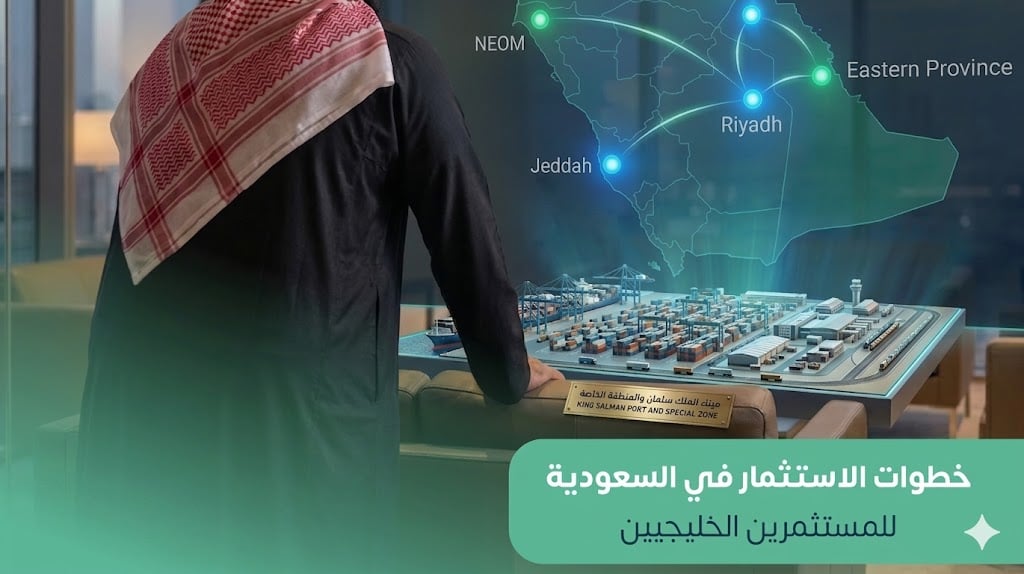
How much capital is required for foreign investment in Saudi Arabia? This is a common question recently, as the Kingdom transforms into an attractive investment hub in line with Vision 2030, creating a sophisticated business environment that welcomes projects with varying financial levels and capital requirements that differ significantly depending on the sector, region, and legal structure of the investment.
This article aims to provide a clear guide highlighting the required financial commitments, while also reviewing the opportunities and incentives that make Saudi Arabia a prime investment destination and the importance of partnering with [a specific entity/entity].Abdulaziz bin Yasser Al-Anzi Law FirmIt guarantees the success and sustainability of your investment from a legal standpoint.
Abdulaziz bin Yasser Al-Anzi Law Firm
The concept of foreign investment in Saudi Arabia
Foreign investment in Saudi Arabia is an investment made by a natural or legal person who does not hold Saudi nationality, through the injection of cash or in-kind capital with the aim of establishing or participating in an establishment with economic activity within the borders of the Kingdom.
This investment takes various legal forms, including establishing a wholly foreign company, creating a branch of an existing foreign company, or entering into a partnership by contributing to the capital of an existing or newly established Saudi company.
This investment comes within the framework of a systematic policy aimed at distributing economic diversification and transferring knowledge in line with the objectives of the Kingdom’s Vision 2030. It is also subject to the supervision and control of the Ministry of Investment, as the official body authorized to issue and regulate investment licenses, and to announce the sectors in which foreign investment is permitted, the amount of capital required for foreign investment in Saudi Arabia, and the ownership percentages allowed for the foreign investor in each activity separately, in accordance with the applicable regulations and Implementing Regulations.
Why do foreign investors prefer to invest in the Kingdom?
The Kingdom of Saudi Arabia boasts a unique investment environment that has made it one of the world's leading destinations for attracting foreign capital, thanks to a set of interconnected advantages and policies supported by a clear legal framework, most notably:
- Establishing clear, easy-to-understand investment laws aimed at protecting investors’ rights and providing them with a safe environment, with the government’s commitment to providing continuous regulatory and legislative facilities to simplify procedures.
- Achieving equal treatment between Saudi and foreign investors, providing strong protection for property and investments, with access to a fair judicial system to resolve disputes and ensure long-term legal security.
- Exempting limited liability companies from the minimum capital requirement, and supporting the Human Resources Development Fund for part of citizens’ salaries during establishment, to alleviate initial operational burdens.
- The Kingdom's continuous investment in infrastructure development, coupled with a stable economy characterized by low inflation rates and high purchasing power, provides a solid foundation for growth.
- The Kingdom possesses enormous natural wealth that supports the energy and mining sectors, which are attractive to investment, with the removal of many economic restrictions that have led to the opening up of diverse competitive sectors.
- Facilitating the entry and residency procedures for foreign employees and their families to participate in investment projects, to ensure the availability of global talent.
- The Kingdom is committed to ensuring the sustainability of investment in exchange for investors' compliance with local and international labor, health, safety and environmental rules, and to striving to create a responsible and stable work environment.
Basic requirements for foreign investment
Foreign investment operations in the Kingdom of Saudi Arabia are subject to basic requirements, regardless of the nature of the activity, as follows:
- Obtaining an investment license from the Ministry of Investment, after submitting the required documents, accurately defining the economic activity within the approved classifications, and attaching a feasibility study or a detailed business plan for the proposed project.
- Knowing how much capital is required for foreign investment in Saudi Arabia and adhering to it, as it varies according to the sector and the legal structure of the entity.
- The minimum required capital must be deposited into a special bank account with one of the licensed banks in the Kingdom, in the name of the entity to be established, before commencing business activity.
- Completing the entity’s commercial registration with the Ministry of Commerce after obtaining the license, and documenting the articles of incorporation and other legal contracts in accordance with the provisions and regulations in force in the Kingdom.
Key promising investment opportunities under Vision 2030
The Kingdom seeks to diversify its economy by opening key strategic sectors to foreign direct investment, offering various incentives. The most prominent of these opportunities include:
- The shift from traditional reliance on oil and gas to large investments in solar and wind power, while providing opportunities in the areas of production, storage, and energy efficiency technologies.
- Strong government support for advanced technology sectors such as artificial intelligence, cybersecurity, the Internet of Things, and big data, and providing a favorable environment for the growth of technology startups and data centers.
- Huge investments to develop health infrastructure, and increasing demand for modern health technologies, medical devices, and pharmaceutical research and development.
- The focus is on new higher education and vocational and technical training to align outputs with the labor market, while providing opportunities in the establishment of educational institutions, specialized training programs, and educational technologies.
- Supporting the "Made in Saudi Arabia" initiative to boost local production and reduce imports, while providing opportunities in manufacturing industries, localizing supply chains, and integrated logistics services.
Foreign investment fees in Saudi Arabia
It is important to know the foreign investment fees in Saudi Arabia, which can be explained as follows:
- The fees for a foreign investment license in Saudi Arabia amount to 2,000 Saudi Riyals annually for a maximum of 5 years, for activities in contracting, tourism, health, education, advertising, real estate development, transportation, shipping, and financial services.
- Foreign investors are required to pay an annual subscription fee of 10,000 Saudi Riyals in the first year to benefit from the services of the Investor Relations Center of the Ministry of Investment, and this fee may increase in subsequent years to reach 60,000 Saudi Riyals annually.
How much capital is required for foreign investment in Saudi Arabia?
As for the minimum capital required for foreign investment in Saudi Arabia, it varies depending on the type of activity to be carried out, as follows:
- The minimum capital required for investment in agricultural establishments is 42 million Saudi Riyals.
- The minimum capital required for company investment is 500,000 Saudi Riyals.
- The minimum capital required for investment in industrial facilities is 5 million Saudi Riyals.
- The minimum capital required for investment by sole proprietorships is 100,000 Saudi Riyals.
- The minimum capital required for investment in other establishments is one million Saudi Riyals.
Strategies for reducing foreign investment costs in Saudi Arabia
You can adopt a range of effective strategies that will help you maximize the returns on your investment project and control initial and operational expenses, through:
- Taking advantage of government incentives through targeted investment in supported sectors such as technology and industry that offer tax exemptions and other incentives.
- Obtain excellent advice from consulting firms to help you understand the local regulatory environment and avoid costly mistakes, and to advise you on the optimal legal structure and efficient company formation pathways.
- Investing in special economic zones, which provide a favorable investment environment that includes tax and customs exemptions and flexible procedures, contributes significantly to reducing operating costs and fees.
- Contracting with specialized local business services companies with the aim of reducing the costs of legal and accounting consultations, and completing the incorporation procedures accurately and quickly.
- Relying on developing internal processes and integrating technology to increase productivity and reduce operating costs sustainably in the long term.
The most important challenges that a foreign investor may face in the Kingdom
Despite the attractive incentives offered by the Kingdom of Saudi Arabia for foreign investment, there are some challenges that you may face as a foreign investor, and knowing them will greatly help you overcome them. The most prominent of these challenges are:
Adapting to updated legislation and laws
Regulations and laws are subject to continuous updating in line with the objectives of Vision 2030. This requires you, as a foreign investor, to follow these updates closely and to seek the assistance of legal advisors specializing in Saudi legislation to avoid procedural risks and unplanned delays.
Compliance with local financial and tax regulations
The Kingdom of Saudi Arabia adopts tax and accounting systems with special standards, such as value-added tax and corporate tax. It is essential to understand these obligations and their effects on capital structure and flows, and to use locally accredited accounting and legal firms as a basic precautionary measure.
Workforce localization requirements
Regulations require most companies to achieve specific percentages of Saudi personnel in their total workforce. This requires you to develop national recruitment and training strategies, and integrate these requirements into operating costs and long-term financial planning.
Administrative and bureaucratic procedures
Some projects, especially complex ones, may face unexpected timeframes for completing procedures with different entities. Overcoming this challenge depends on careful advance planning, preparing files according to regulatory specifications, and managing project schedule expectations accordingly.
Cultural and linguistic barriers
Differences in work culture and communication styles, in addition to Arabic being the official language of government transactions, may pose an obstacle that requires adaptation or reliance on local partners.
Increasing local competition
As the market opens up, competition intensifies with established local entities that have a deeper understanding of the consumer environment and distribution channels.
Market fluctuations and demand
Like any dynamic economy, some sectors may be subject to fluctuations in prices or demand, which necessitates high flexibility in financial planning and risk management.
In conclusion, after reviewing the requirements and opportunities for foreign investment in the Kingdom, the important question remains: How much capital is required for foreign investment in Saudi Arabia?
This question cannot be answered with fixed numbers, as it is a delicate equation related to choosing the right sector, the optimal legal structure, and making the most of incentives and facilities. This is where the role of the legal specialist comes in, who turns challenges into guaranteed opportunities.
It doesn't offer youAbdulaziz bin Yasser Al-Anzi Law FirmIt doesn't just provide theoretical answers, but puts in your hands practical strategies that accompany you from the first moment of analyzing the feasibility of your project and determining the appropriate capital, completing all legal and incorporation procedures smoothly and transparently, and even protecting your investment and ensuring its growth in full compliance with local regulations and laws.
Don't let financial requirements or legal complexities stand in the way of your ambition; contact us now.Abdulaziz bin Yasser Al-Anzi Law FirmMake your investment in Saudi Arabia a safe and profitable journey on solid ground of knowledge and experience.Contact us،